The Website Portfolio Strategy Nobody Talks About
David Stetler · GES Development LLC · March 2026
When I built PaintingA2.com, I thought I was building a website. A directory connecting homeowners in Ann Arbor with local painting contractors. Simple enough. But somewhere along the way I realized I wasn’t just building a website—I was documenting a playbook. Every decision, every marketing test, every revenue milestone was being recorded. And that playbook? It doesn’t just work for painting in Ann Arbor. It works anywhere there’s a trade and a city that needs it.
That realization changed everything about how I think about building online.
The One-Idea Trap
Here’s something nobody talks about in the web development world: what happens after you launch your one idea?
You build a website. Maybe it’s a directory. Maybe it’s a local service site. Maybe it’s a niche blog. If it works, you make some money. Good for you. But then what? You sit on it. You optimize it a little. You tweak the copy. And then you start scrolling through forums looking for the next big idea—because somehow, one success feels like the ceiling, not the foundation.
This is the One-Idea Trap, and it catches almost everyone. Business owners, web developers, digital entrepreneurs—they pour everything into one concept, and then they’re done. The conventional advice is to “build up.” Add features. Upsell. Expand the service. And sure, that works to a point. But how far can one idea really go?
Not as far as you think. There’s a ceiling on building up. But there’s almost no ceiling on building out.
The Build Out, Then Build Up Framework
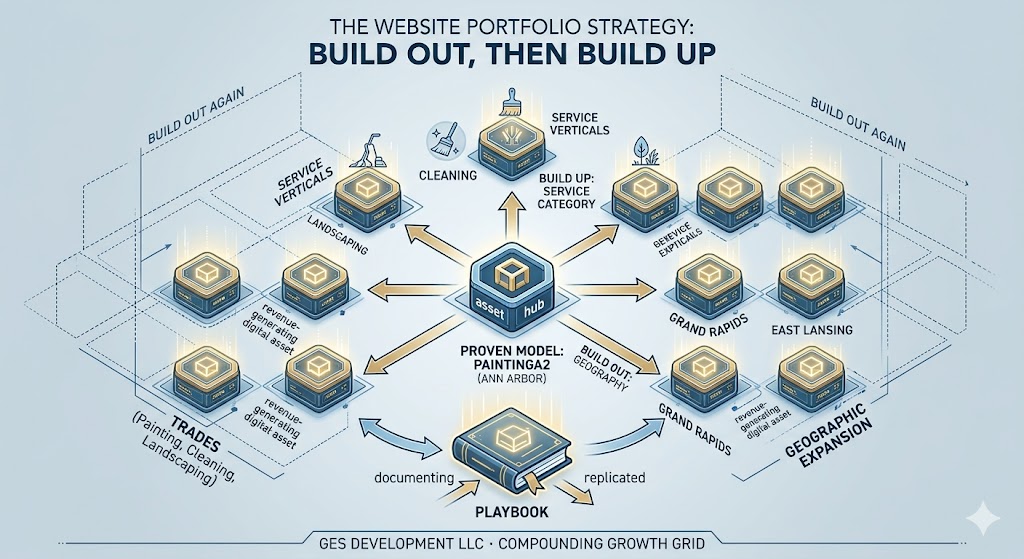
Building out means you take a proven concept and replicate it geographically. Building up means you take a proven market and expand into adjacent services. The order matters.
Step 1: Prove the Model
PaintingA2.com was the proof of concept. A hyperlocal directory for painting contractors in Ann Arbor, Michigan. The site generates revenue through contractor listings and lead generation. More importantly, I documented every step—the tech stack, the marketing channels, the content strategy, the monetization model. That documentation is the asset, not just the website.
Step 2: Build Out (Geography)
Once PaintingA2 proved the model, the next move isn’t to add plumbing listings to the same site. It’s to take the exact same playbook and deploy it in Grand Rapids. Then East Lansing. Then Kalamazoo. Same framework, same marketing approach, same revenue model. Different zip code.
This is where the math gets interesting. If PaintingA2 earns $200 a month, and you follow the same footwork in two more cities, you’re at $600 a month from one idea replicated three times. No new concept. No new learning curve. Just execution.
Step 3: Build Up (Service Category)
Only after you’ve exhausted the geographic build-out do you build up. Take the original city—Ann Arbor—and launch a new service vertical. CleaningA2. LandscapingA2. RoofingA2. Each one targets a different trade that’s still in high demand locally.
Step 4: Build Out Again
Now you repeat the geographic expansion with the new vertical. CleaningGR. CleaningEastLansing. Every time you build up, you unlock a new row of build-out opportunities.
The result is a grid—cities on one axis, trades on the other—and every cell in that grid is a revenue-generating digital asset.
The Math That Changes Your Mind
I’ll be the first to tell you: you’re not going to make a million dollars from a single directory or lead generation website. Maybe after 40 years, but not right away.
But that’s not the play. The play is compounding modest revenue across a replicable portfolio.
Here’s how the numbers work with just $200/month per brand:
- PaintingA2 (Year 1): $200/month = $2,400/year
- Build Out to 3 cities (Year 2): $600/month = $7,200/year
- Build Up with 1 new trade (Year 2-3): $1,200/month = $14,400/year
- Build Out that trade to 3 cities (Year 3): $1,800/month = $21,600/year
- 3 trades × 5 cities (Year 4-5): $3,000/month = $36,000/year
None of those individual numbers are life-changing. But the portfolio is. And every new brand you add gets easier to launch, because the playbook is already written.
Why Build Out Before Building Up
The order isn’t arbitrary. Building out first has three structural advantages.
First, there’s no new learning curve. You already know the market. You already know what content converts. You already know which ad channels work. When you take PaintingA2 to Grand Rapids, you’re not starting from scratch—you’re deploying a proven system.
Second, building out has a much higher ceiling. There are only so many home service trades that are still in demand. That’s a finite list. But there are hundreds of cities where those trades are needed. Geography is your multiplier, not service diversity.
Third, geographic expansion creates portfolio resilience. If one local market softens, others pick up the slack. You’re not dependent on a single city’s economy.
The Real Asset Isn’t the Website
Here’s what most people miss: the most valuable thing I built wasn’t PaintingA2 itself. It was the documented process of building PaintingA2. The tech stack decisions, the Sanity CMS setup, the Next.js routing, the Facebook ad campaigns, the contractor outreach strategy, the content calendar—all of it, recorded and repeatable.
That playbook is the engine. The websites are the output. And because the engine exists, every new brand launches faster, costs less, and reaches profitability sooner than the last one.
At GES Development, we treat every website as a brand—a long-term digital asset that compounds in value over time. Not a client project. Not a one-off build. An asset in a portfolio, designed to generate revenue and grow.
What’s Next
We’re actively executing this framework. The next deployments on the roadmap include GrandRapids.help, PaintingGR, EastLansing.help, and PaintingEastLansing. Same proven model. New markets. More cells in the grid.
If you’re a developer, a small business owner, or someone sitting on one profitable idea wondering what’s next—stop looking for a new trick. Take what works and build it out. Then build up. Then build out again.
The framework is simple. The ceiling is high. And the playbook is already written.
David Stetler
Owner & Founder, GES Development LLC